
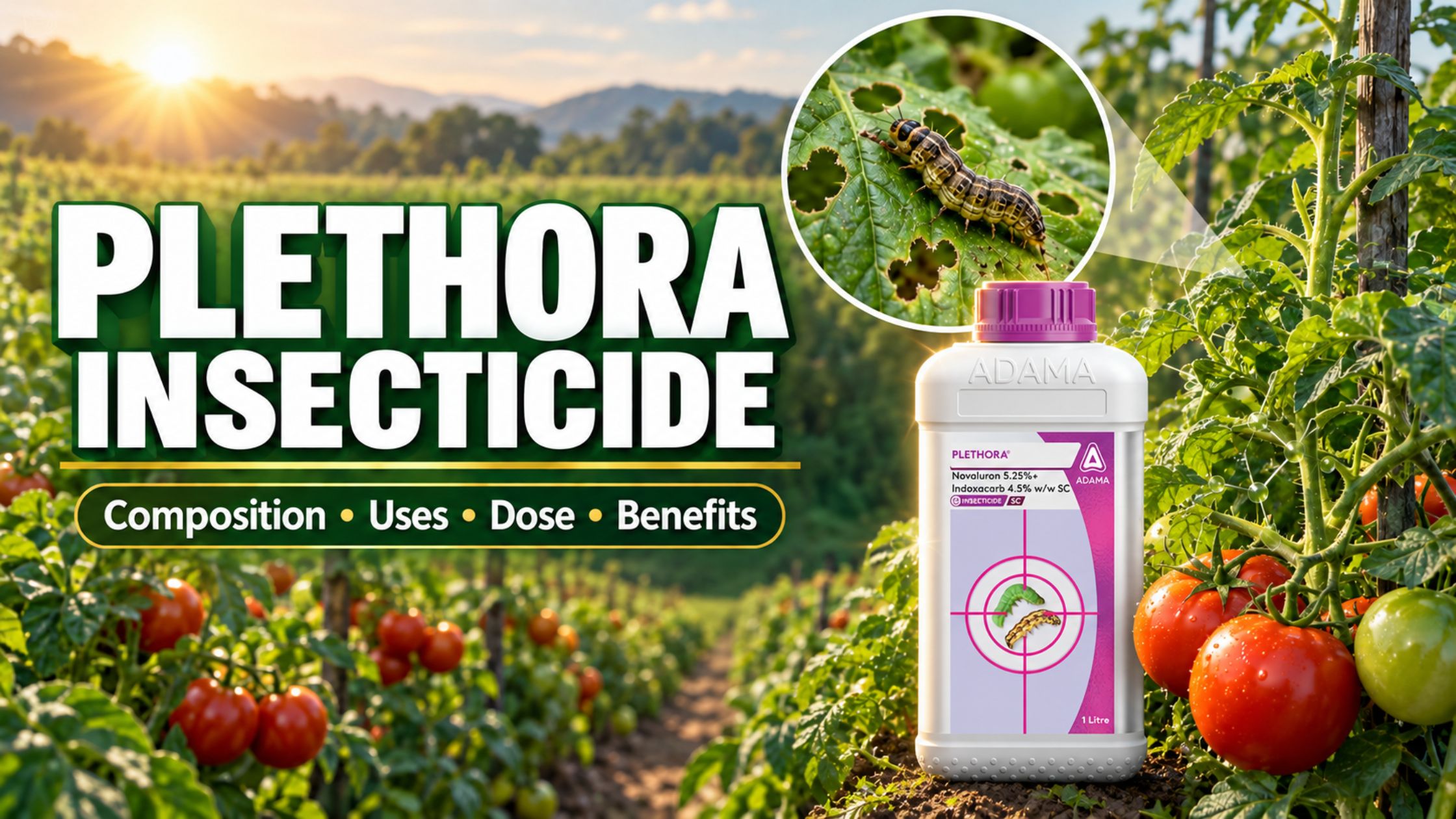
Plethora Insecticide Review
Caterpillars and borers can cause serious crop losses by feeding on leaves, flowers, pods and fruits. Once larvae enter fruits or pods, controlling them becomes more difficult. Plethora Insecticide from ADAMA offers a dual mode of action for managing several economically important lepidopteran pests.
Plethora combines an insect-growth regulator with a nerve-action insecticide. This combination attacks caterpillars in two different ways—interfering with moulting and causing paralysis—making it particularly useful where different larval stages occur together.
Important clarification: Plethora is an insecticide, not a fungicide or bactericide. It controls specified insect pests, not plant diseases such as blight, wilt, mildew, rust or leaf spot.
Plethora Insecticide at a Glance
| Particular | Details |
|---|---|
| Brand name | Plethora |
| Manufacturer/marketer | ADAMA India |
| Product category | Broad-spectrum lepidopteran insecticide |
| Chemical composition | Novaluron 5.25% + Indoxacarb 4.5% w/w SC |
| Formulation | Suspension Concentrate (SC) |
| Primary action | Contact and stomach action |
| Target pest group | Caterpillars, fruit borers, pod borers and leaf folders |
| Recommended crops | Tomato, chilli, rice, soybean, groundnut, chickpea, pigeon pea and black gram |
| Common pack sizes | 50 ml, 100 ml, 350 ml, 500 ml and 1 litre |
| Application method | Foliar spray |
ADAMA describes Plethora as a broad-spectrum lepidopteran insecticide with a dual mode of action. Its official Indian product page lists tomato, chilli, rice, soybean, groundnut, chickpea, pigeon pea and black gram among the recommended crops.
Buy Plethora Insecticide Online
Click on the “Read More” button or Image to buy it online on pradhanagro.co.in
Plethora Insecticide Chemical Composition
Plethora contains:
- Novaluron 5.25% w/w
- Indoxacarb 4.5% w/w
- Formulated as a Suspension Concentrate, abbreviated as SC.
The percentages indicate the amount of each active ingredient by weight in the formulated product.
What is Novaluron?
Novaluron is an insect-growth regulator. It interferes with the synthesis of chitin, an essential component of an insect’s outer body covering.
Caterpillars need to shed their old skin and form a new one as they develop. When chitin formation is disrupted, successful moulting becomes difficult. The treated larvae consequently stop developing and eventually die.
Novaluron is therefore particularly useful against immature larval stages. Its effect may not always appear as an immediate knockdown because it works through growth disruption.
What is Indoxacarb?
Indoxacarb acts on the insect nervous system by blocking sodium-ion movement through nerve-cell channels. This disrupts normal nerve signalling, causing feeding cessation, paralysis and eventual death.
After exposure or ingestion, affected larvae generally stop feeding before they die. This early feeding stoppage helps limit further crop damage.
ADAMA states that Plethora simultaneously inhibits chitin formation and affects the insect nervous system, thereby disrupting moulting and paralysing susceptible insects. (ADAMA India)
Table of Contents
How Does Plethora Insecticide Work?
Plethora controls susceptible caterpillars through complementary actions:
- Larvae come into contact with treated plant surfaces or consume treated foliage.
- Indoxacarb interferes with sodium channels in the insect nervous system.
- The larvae become inactive, stop feeding and are subsequently paralysed.
- Novaluron prevents normal chitin formation and moulting.
- Larval development is interrupted, resulting in death and reduced progression to the adult stage.
This combined activity makes Plethora useful when young and more developed caterpillars are present at the same time.
IRAC Mode-of-Action Groups
The two ingredients belong to different mode-of-action groups:
- Novaluron: IRAC Group 15—inhibitor of chitin biosynthesis affecting insect growth and development.
- Indoxacarb: IRAC Group 22A—voltage-dependent sodium-channel blocker.
Although Plethora contains two active ingredients, it should not be sprayed repeatedly throughout the season. Rotate it with effective products from mode-of-action groups other than Groups 15 and 22A.
Major Benefits of Plethora Insecticide
1. Dual mode of action
The combination attacks susceptible pests through both growth regulation and nerve disruption.
2. Effective against important caterpillars
It is intended primarily for lepidopteran pests such as fruit borers, pod borers, leaf-eating caterpillars, semi-loopers and rice leaf folder.
3. Feeding stops after treatment
Indoxacarb causes affected larvae to stop feeding, helping to reduce additional damage to leaves, flowers, pods and fruits.
4. Controls mixed larval populations
Novaluron performs strongly against developing larvae, while indoxacarb adds contact and ingestion activity. The combination can therefore help manage a mixed population of susceptible caterpillar stages.
5. Quick action with residual protection
Indoxacarb contributes comparatively rapid feeding cessation, while novaluron provides growth-disrupting activity against developing larvae.
6. Protects marketable produce
Timely control of fruit and pod borers may reduce damaged tomato fruits, chilli fruits and pulse pods, improving the proportion of marketable produce.
7. Multiple-crop utility
A single formulation is listed for several vegetable, pulse, oilseed and cereal crops, subject to the directions printed on the purchased pack.
8. Phytotonic effect claimed by the manufacturer
ADAMA reports a phytotonic effect on treated crops. However, Plethora should be selected for controlling labelled insect pests—not used as a substitute for fertiliser, micronutrients or plant-growth regulators. (ADAMA India)
Plethora Recommended Crops, Target Pests and Dose
The following table presents commonly published crop recommendations for the Novaluron 5.25% + Indoxacarb 4.5% SC formulation. Local registrations and labels may change, so the label supplied with the product must take priority.
| Crop | Target insect pests | Formulation dose per hectare | Approximate dose per acre |
|---|---|---|---|
| Tomato | Fruit borer and leaf-eating caterpillar | 825–875 ml | 330–350 ml |
| Chilli | Helicoverpa armigera, leaf-eating caterpillar and Spodoptera litura | Around 875 ml | Around 350 ml |
| Soybean | Spodoptera litura, Helicoverpa armigera and semi-looper | Around 875 ml | Around 350 ml |
| Pigeon pea/red gram | Pod-borer complex, including Helicoverpa and Maruca | Around 875 ml | Around 350 ml |
| Chickpea/gram | Pod-borer complex | Around 875 ml | Around 350 ml |
| Black gram | Pod-borer complex, including Helicoverpa, Etiella and Maruca | Around 875 ml | Around 350 ml |
| Rice/paddy | Rice leaf folder | Around 437.5 ml | Around 175 ml |
| Groundnut | Helicoverpa armigera and Spodoptera litura | Around 875 ml | Around 350 ml |
Published crop recommendations for this formulation identify these crop–pest combinations; the confirmed tomato label rate is 825–875 ml per hectare in 500 litres of water. (Gharda Chem)
Important dosage note
Do not apply one universal “ml per litre” rate without considering the recommended dose per unit area. Water volume varies according to crop canopy, sprayer, nozzle and growth stage.
For example, a dose of 350 ml per acre mixed in 200 litres of water equals approximately 1.75 ml per litre. If the same 350 ml is applied using 150 litres of water, the concentration changes, but the dose per acre remains 350 ml.
Always calculate:
Quantity required = Recommended dose per acre × Actual area to be sprayed
Does Plethora Control Plant Diseases?
No. Plethora does not directly control fungal, bacterial or viral diseases.
It should not be recommended for:
- Early or late blight
- Damping-off
- Powdery mildew
- Downy mildew
- Rust
- Anthracnose
- Fusarium or bacterial wilt
- Leaf spot
- Mosaic or leaf-curl viruses
Some farmers loosely use the word “disease” for every crop problem. In technical crop protection, Plethora controls insect pests, particularly caterpillars and borers.
It will also not cure viral diseases transmitted by insects after plants have become infected. Furthermore, it is not primarily intended for controlling sucking pests such as aphids, jassids, whiteflies, thrips or planthoppers unless a particular pest is expressly included on the current label.
Best Time to Apply Plethora
Apply Plethora when:
- Pest incidence reaches the locally recommended economic threshold.
- Eggs begin hatching and young larvae are visible.
- Early leaf scraping, webbing or feeding damage appears.
- Fruit or pod entry is still limited.
- Weather conditions permit proper spray deposition.
Young caterpillars are normally easier to control than fully developed larvae. Waiting until numerous larvae have entered fruits, pods or folded leaves can reduce the practical effectiveness of any foliar insecticide.
Regular field scouting is therefore essential.
How to Use Plethora Insecticide
- Inspect the field and confirm the identity of the insect pest.
- Read the product label and measure the required quantity accurately.
- Fill the spray tank approximately one-third to one-half with clean water.
- Shake the Plethora container before measuring.
- Mix the measured insecticide separately with a small amount of water.
- Add this premix to the spray tank while stirring.
- Add the remaining water and maintain agitation.
- Spray uniformly over the crop, covering the upper and lower leaf surfaces and pest-prone plant parts.
- Use the complete spray mixture on the day it is prepared.
- Wash the sprayer safely after application without contaminating ponds, canals or drinking-water sources.
The product leaflet advises preparing a premix with a small quantity of water before adding the remaining water and permits suitable high-volume equipment such as knapsack, compression, foot or motorised sprayers fitted with appropriate nozzles. (sahibgroup.in)
Recommended Water Volume
For tomato, the registered label information specifies approximately 500 litres of water per hectare, equivalent to roughly 200 litres per acre, depending on crop canopy and application equipment. (sahibgroup.in)
For other crops, follow the crop-specific instructions on the current pack. The objective is uniform coverage without excessive runoff.
Precautions and Safe Handling
Plethora is an agricultural pesticide and must be handled responsibly.
- Wear gloves, long clothing, closed footwear, eye protection and a suitable mask during mixing and spraying.
- Do not eat, drink, smoke or chew while handling the insecticide.
- Avoid contact with the skin, eyes and mouth.
- Avoid inhaling spray mist.
- Spray in the direction of the wind, never against it.
- Do not clear a blocked nozzle by blowing through it with the mouth.
- Do not spray immediately before rain or during strong winds.
- Prevent spray drift onto neighbouring crops, homes and water bodies.
- Keep children, livestock and unprotected people away from the treated area.
- Do not reuse the empty container.
- Dispose of empty packaging according to local regulations and label instructions.
- Wash hands, face, clothing and equipment thoroughly after use.
- In case of suspected poisoning or significant exposure, seek medical assistance immediately and carry the product label or container.
The official label warns that the product is toxic to fish and aquatic organisms. It should not be used near aquaculture or allowed to contaminate lakes, ponds, streams or other aquatic environments.
Waiting Period Before Harvest
The waiting period is the minimum interval between the final spray and harvesting the crop.
For the tomato use recorded on the formulation label, the waiting period is five days. (sahibgroup.in)
Waiting periods may differ by crop. Follow the crop-specific waiting period printed on the current Plethora label. Never assume that the tomato waiting period automatically applies to rice, pulses, oilseeds or chilli.
Resistance-Management Guidelines
Repeated use of the same insecticide groups can select resistant pest populations. To delay resistance:
- Apply only when pest monitoring indicates a genuine need.
- Target early larval stages.
- Avoid repeated back-to-back Plethora applications.
- Rotate with insecticides having different IRAC group numbers.
- Do not rely on mixtures containing novaluron or indoxacarb again in the next rotation.
- Observe the maximum number of applications stated on the label.
- Combine chemical treatment with pheromone traps, light traps, removal of damaged plant parts and conservation of natural enemies.
- Control weeds and alternate hosts where appropriate.
- Never increase the dose to overcome suspected resistance.
Plethora’s Role in Integrated Pest Management
Plethora should be one component of an integrated pest-management programme rather than the only method of control.
A practical IPM programme may include:
- Weekly crop scouting
- Pheromone traps for monitoring moth activity
- Destruction of badly infested fruits, shoots or pods
- Removal of pest-infested crop residues
- Balanced fertilisation, particularly avoiding excessive nitrogen
- Bird perches in suitable field crops
- Conservation of predators and parasitoids
- Biological products where locally recommended
- Need-based application of registered insecticides
- Rotation between unrelated modes of action
This approach can improve control while reducing unnecessary pesticide use and resistance pressure.
Advantages and Limitations
| Advantages | Limitations |
|---|---|
| Two active ingredients with different modes of action | Does not control fungal, bacterial or viral diseases |
| Strong utility against caterpillars and borers | Not a universal solution for sucking pests or mites |
| Contact and stomach activity | Best results require timely application on young larvae |
| Helps stop feeding and disrupt larval development | Larvae already deep inside fruits or pods may be harder to reach |
| Registered/listed across several crops | Repeated use can contribute to resistance |
| SC formulation is convenient for foliar spraying | Hazardous exposure and water contamination must be prevented |
Overall Review: Is Plethora a Good Insecticide?
Plethora is a useful dual-action insecticide for farmers facing caterpillar and borer problems in crops such as tomato, chilli, pulses, soybean, rice and groundnut. Its combination of novaluron and indoxacarb provides two complementary effects: interruption of larval development and disruption of insect nerve function.
Its main strength lies in controlling lepidopteran larvae, especially when the spray is applied at the beginning of infestation. It should not, however, be considered an all-purpose pesticide. It does not replace fungicides, sucking-pest insecticides, miticides or good crop-management practices.
The product can deliver dependable results when the pest is correctly identified, young larvae are targeted, field coverage is adequate and label directions are followed.
Frequently Asked Questions
1. What is the technical name of Plethora Insecticide?
Plethora contains Novaluron 5.25% + Indoxacarb 4.5% w/w SC.
2. Which company manufactures Plethora?
Plethora is marketed in India by ADAMA India.
3. Is Plethora a systemic or contact insecticide?
It is principally described as a contact and stomach-action insecticide. Avoid describing it as fully systemic unless the current label specifically makes that claim.
4. Which insects does Plethora control?
It controls labelled lepidopteran pests such as fruit borers, pod borers, leaf-eating caterpillars, semi-loopers, Spodoptera species and rice leaf folder.
5. What is the Plethora dose per acre?
The commonly published rate is approximately:
- Tomato: 330–350 ml per acre
- Rice: around 175 ml per acre
- Chilli, soybean, chickpea, pigeon pea, black gram and groundnut: around 350 ml per acre
The current product label must be followed because approved rates may differ by crop or registration status.
6. What is the Plethora dose per litre of water?
A universal per-litre dose is not the most accurate recommendation because Plethora is registered on an area basis. If 350 ml is used with 200 litres of water per acre, the calculated concentration is approximately 1.75 ml per litre. Follow the label’s dose per acre and recommended water volume.
7. Can Plethora be used on tomato?
Yes. It is recommended against tomato fruit borer and leaf-eating caterpillar at approximately 825–875 ml per hectare, or 330–350 ml per acre.
8. Can Plethora control tomato leaf-curl disease?
No. Tomato leaf curl is a viral disease. Plethora neither cures infected plants nor specifically serves as the standard solution for its whitefly vector.
9. Can Plethora control thrips, aphids and whiteflies?
These sucking pests are not its principal labelled targets. Select a registered sucking-pest insecticide according to local agricultural advice.
10. Can Plethora control mites?
No. It is not a dedicated miticide.
11. Can Plethora be used for fall armyworm in maize?
Do not apply it to maize unless maize and fall armyworm appear on the current label applicable in your area. A product being effective against one Spodoptera species does not automatically authorise its use against another pest or on an unlisted crop.
12. How quickly does Plethora work?
Affected larvae may stop feeding relatively quickly following exposure to indoxacarb. Complete mortality can take longer because novaluron works by interfering with development and moulting.
13. When is the best stage to spray Plethora?
Apply at the early infestation stage, preferably when larvae are young and before they enter fruits, pods or tightly folded leaves.
14. Can Plethora be mixed with a fungicide or fertiliser?
Do not make an unverified tank mixture. Check both labels and obtain advice from ADAMA or a qualified agricultural professional. If a mixture is permitted, conduct a small jar-compatibility test before preparing a full tank.
15. Can Plethora be sprayed during flowering?
Avoid spraying when bees are actively visiting flowers. If label-authorised treatment is unavoidable, apply when pollinator activity is lowest and prevent direct contamination of flowers and nearby hives.
16. Can Plethora be used repeatedly?
Repeated applications are not recommended. Rotate with insecticides from different IRAC groups and observe the label’s application limit.
17. Does Plethora improve crop growth?
ADAMA mentions a phytotonic effect, but Plethora is fundamentally an insecticide. It should not be used as a fertiliser, growth promoter or substitute for balanced nutrition. (ADAMA India)
18. What should be done if it rains after spraying?
Follow the label and local technical advice. If heavy rain occurs shortly after application, do not automatically repeat the spray; first assess pest survival and whether retreatment is both necessary and permitted.
19. Is Plethora safe for fish?
No pesticide should be considered harmless to aquatic organisms. The official Plethora label identifies a risk to fish and aquatic life, so it must not contaminate ponds, streams, canals or aquaculture areas.
20. Where should Plethora be stored?
Keep it in its original, tightly closed container in a locked, cool, dry and well-ventilated pesticide-storage area, away from food, animal feed, medicines, children, livestock, direct sunlight and heat.
Conclusion
Plethora Insecticide is a dual-action formulation containing Novaluron 5.25% + Indoxacarb 4.5% w/w SC. It is especially valuable for managing fruit borers, pod borers, leaf-eating caterpillars, semi-loopers and rice leaf folder across several labelled crops.
For best results, identify the pest correctly, spray against young larvae, use the crop-specific dose, ensure thorough coverage, and rotate modes of action. Most importantly, treat Plethora as an insect-control product—not as a remedy for plant diseases or every type of agricultural pest.
Also Read: All other Insecticide Review
Disclaimer: This article is for educational purposes. Pesticide registrations, crops, doses, application limits and waiting periods may change. Always read and follow the current container label and consult the manufacturer, local agriculture department or qualified crop adviser before application.