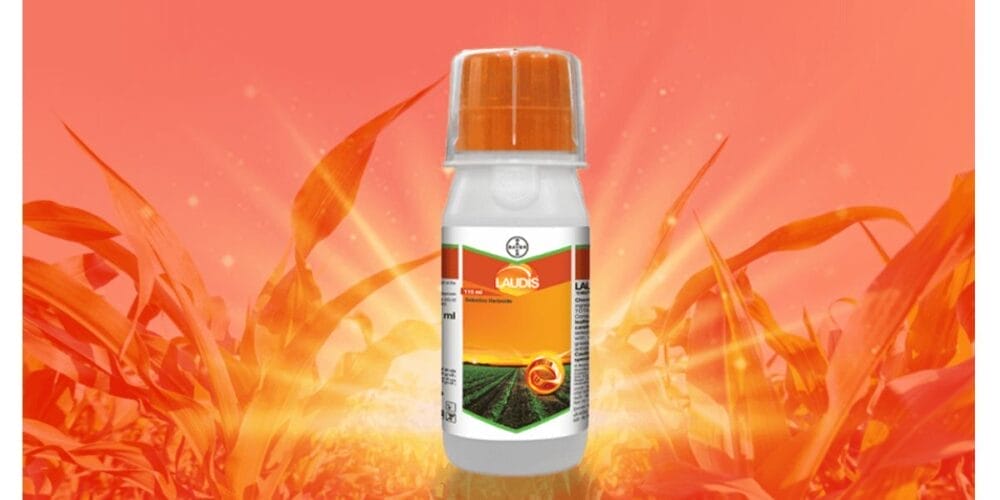
Introduction of Bayer Laudis® Herbicide
Short description (SEO): Laudis® herbicide (active ingredient tembotrione) is a post-emergence HPPD inhibitor from Bayer formulated for corn (field, sweet and seed) to deliver fast burndown and useful residual control of a broad spectrum of grassy and broadleaf weeds. Recommended single-application rates range from 145–220 mL/ha and — in common spray volumes — work out to roughly ~1 mL per litre of spray mix.
Table of Contents
What is Laudis®? (Technical name & mode of action)
Laudis® is a Bayer crop-protection herbicide whose active ingredient is tembotrione (marketed as a suspension concentrate formulation — commonly listed as Tembotrione 34.4% w/w / ~420 g/L SC formulations on product literature). Tembotrione belongs to the HPPD (4-hydroxyphenylpyruvate dioxygenase) inhibitor group (Group 27) — it blocks carotenoid biosynthesis, causing chlorophyll bleaching and rapid loss of weed vigour after application.
Also Read: Bayer Ghasa Herbicide: Complete Guide for Farmers
Recommended dose & application timing of Bayer Laudis® Herbicide
Label guidance (Bayer) specifies a per-hectare application rate of 145–220 mL/ha, chosen according to the target species and weed size/density. Apply Laudis at the 2– to 5-leaf stage of corn for best results (some tank-mix and sequential options exist for larger or hard-to-control weeds). A maximum of two applications is allowed in field/seed corn (one in sweet corn) with label limits and intervals that must be followed.




Practical farmer conversions (typical spray volumes):
- Spray volume recommended: 150–200 L/ha for good coverage.
- Therefore:
- At 145 mL/ha in 150 L/ha water → ≈ 0.97 mL per L (≈1 mL/L).
- At 220 mL/ha in 200 L/ha water → 1.10 mL per L.
Farmers and spray operators commonly prepare Laudis at roughly ~1 mL per litre of spray mix for routine post-emergence work, but always match the per-ha label rate to your chosen spray volume.
Uses — crops & weeds controlled of Bayer Laudis® Herbicide
Laudis is intended primarily for field corn, seed corn and sweet corn. It provides post-emergence control or suppression of many annual broadleaf and grassy weeds — examples on the label include velvetleaf, redroot pigweed, common lamb’s-quarters, common and giant ragweed, giant and green foxtail, waterhemp, volunteer canola and wild buckwheat (rates and effectiveness vary by species and growth stage). For dense populations or resistant biotypes, the higher end of the rate range (220 mL/ha) or specified tank-mix partners are recommended.
Also Read: Bayer Council® Activ Herbicide – Complete Guide for Farmers
Key benefits of Bayer Laudis® Herbicide for growers

- Fast visible activity — weed growth often ceases within hours; bleaching and necrosis follow within 7–14 days.
- Broad spectrum — controls many common grasses and broadleaf weeds in maize, including some difficult species when used at the correct rate or in tank mix.
- Flexible timing — post-emergence window (2–5 leaf) and the option for a single follow-up application (observing label limits) give practical in-season flexibility.
- Resistance management tool — different mode of action (HPPD inhibitor) makes Laudis useful in rotation or mixes to manage herbicide resistance when used responsibly.
Spray adjuvants, tank-mixes and application tips of Bayer Laudis® Herbicide
Laudis is a suspension concentrate that requires an external adjuvant system — recommended options include methylated seed oil (MSO), crop oil concentrates, or the specified HSOC products, plus nitrogen fertilizer (UAN) in certain situations. Spray coverage is critical — use nozzles/pressures that produce MEDIUM droplets, maintain 150–200 L/ha when necessary, and avoid spraying under heavy dew or plant stress. For tough weeds or broader spectrum control, label-listed tank-mix partners (e.g., Pardner or Roundup formulations in specific systems) are available — always follow the most restrictive label when tank-mixing.
Also Read: Bayer Adora Herbicide: A Complete Guide for Effective Weed Management
Safety & crop rotation notes (short) of Bayer Laudis® Herbicide
Observe all label-listed re-planting intervals and crop rotation restrictions — the label provides detailed rotational crop guidance after applications up to the maximum seasonal rates. Do not exceed label application limits and follow personal protective equipment and buffer zone requirements on the label.
FAQs
Q — What is the “dose per litre” I should mix?
A — Use the per-hectare rate from the label (145–220 mL/ha) and divide by your planned spray volume (e.g., 150–200 L/ha). Typical working mixes end up around ~1 mL/L; confirm by calculation for your sprayer.
Q — Can I use Laudis on other crops?
A — Laudis is labeled for corn (field, seed, sweet) — do not use on unlabeled crops. Follow all crop rotation intervals and label directions.
Q — Is Laudis rainfast?
A — The label indicates Laudis is rainfast about 2 hours after application for most species.
Final opinion (practical take)
Laudis (tembotrione) is a modern, reliable post-emergence option for maize growers looking for fast burndown plus residual activity and a different mode of action for resistance management. Its clear label guidance on rates (145–220 mL/ha), adjuvant needs, and spray volumes makes it straightforward to use — but success depends on correct application timing, good coverage, and adherence to label safety and rotation rules. When used as part of an integrated weed-management plan, Laudis is a strong tool in the corn grower’s toolbox.
Also Read: About Laudis Herbicide on the BAYER Site
Bayer Laudis® Herbicide review
Product Cost
Compatibility
Availability
Aggregate Customer Score
Overall Rating: Excellent